Blog

  • How the Japanese Teach Children Independence

    How the Japanese Teach Children Independence

    My son was eight months old when Netflix recommended a show called Old Enough! — a Japanese program where toddlers as young as two are sent on solo errands through busy neighbourhoods. I watched a three-year-old navigate a fish market, cross a road, and deliver groceries to her grandmother. My son was sitting on my lap eating his own fist.

    I did what any reasonable person would do: I went down a research rabbit hole that lasted three weeks.

    What I found wasn’t what the Netflix algorithm was selling. The show is real, the cultural value it captures is real, but the picture most Westerners have of Japanese childhood independence — tiny children roaming free in a society that simply trusts them more — is a comfortable distortion of something far more interesting. And far more useful.

    Because the Japanese don’t just allow childhood independence. They engineer it. Every walking route is mapped. Every neighbourhood has designated safe houses. Older children escort younger ones in organised groups. The community watches. The infrastructure does the heavy lifting. And the child, inside that scaffolding, does something Australian children increasingly never get to do: practise being competent in the real world.

    The Japanese don’t just allow childhood independence. They engineer it. And the child, inside that scaffolding, does something Australian children increasingly never get to do: practise being competent in the real world.

    First, the show versus the reality

    Hajimete no Otsukai (“My First Errand”) has been running in Japan since 1991, inspired by a 1976 picture book by Yoriko Tsutsui and Akiko Hayashi. The children featured range from one year eight months to five years three months. Camera crews wear disguises. No accidents have occurred in over 30 years of production.

    It’s great television. It is not documentary evidence of how Japanese families actually operate.

    A Tokyo Weekender analysis by a parent with experience across Japan, the US, and New Zealand notes plainly: “it is school-age children who are often out alone, not preschoolers.” The cultural practice of children running errands is real, but it applies primarily to children aged six and above. No rigorous survey data exists documenting how widespread solo errands by preschoolers actually are.

    The show amplifies a genuine cultural value — captured by the Japanese proverb kawaii ko ni wa tabi o saseyo, “send the beloved child on a journey” — but it shouldn’t be confused with everyday practice for two-year-olds. Think of it as a culture revealing what it aspires to, not a hidden camera catching what it routinely does.

    The real story starts at age six. And it starts with walking to school.

    93% of Japanese children walk to school. Alone.

    The Japan Sports Agency’s 2018 national survey was not a sample. It was a full census of all 1,095,282 fifth-graders in the country. It found that 92.4% of boys and 93.5% of girls walked to school. Only 1.7% rode a bus. A 2025 prospective study confirmed walking rates of 94.7–96.1%.

    Let that land for a second. In a country of 125 million people, virtually every primary school child walks to school.

    Key Evidence Japan Sports Agency (2018) — Full National Census

    A census of all 1,095,282 Japanese fifth-graders found 92.4% of boys and 93.5% of girls walked to school. Only 1.7% took a bus. The Global Matrix 4.0 on physical activity across 57 countries gave Japan the highest rating (A−) for active transport to school.

    The Policy Studies Institute’s landmark study — 18,303 children aged 7–15 across 16 countries — ranked Japan fifth for children’s independent mobility overall, behind Finland, Germany, Norway, and Sweden. Australia ranked near the bottom, comparable to Ireland and Brazil. E. Owen Waygood at Montréal Polytechnique found that Japanese children aged 10–11 make just 15% of their weekday trips with a parent. For American children the same age, that number is 65%.

    The comparison that haunts me most: in England, 80% of 7–8-year-olds walked to school without an adult in 1971. By 2006, only 12% did. In Australia, children aged 5–9 who walked to school dropped from 57.7% in 1971 to 25.5% by the early 2000s, while car travel nearly tripled. We didn’t make a conscious decision to stop letting children walk. It just happened, one anxious school drop-off at a time.

    But this isn’t “free-range” anything

    Here’s where most Western coverage of Japanese childhood independence gets it wrong. The independence is real, but it’s not the absence of structure. It’s structure of a completely different kind.

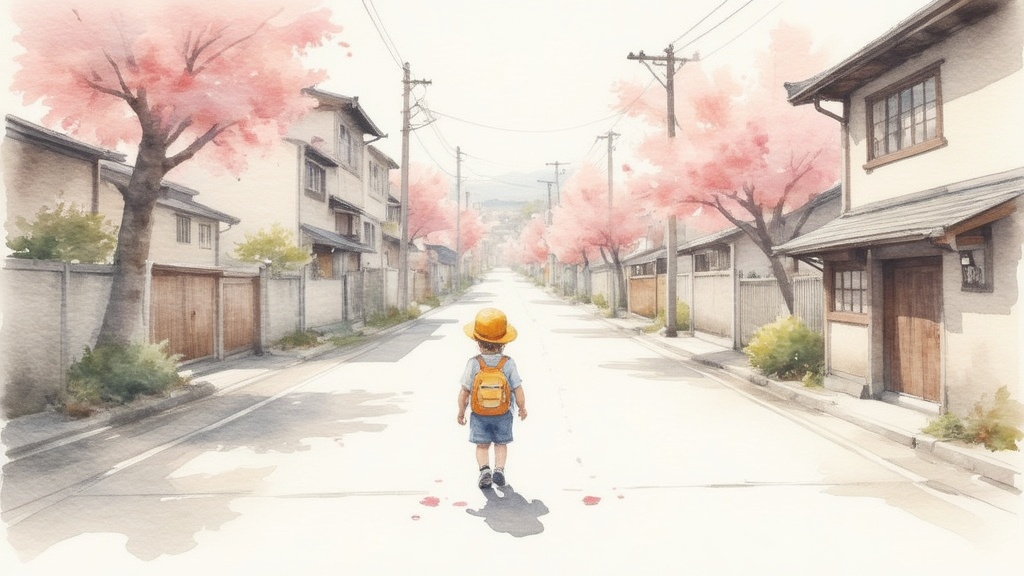
    Before a Japanese child’s first day of school, their parents must draw a detailed map of the walking route — the tsuugaku-ro — and file it with the school. Teachers and local residents determine which routes are safest. School zones are closed to vehicular traffic during commute times. Children walk in neighbourhood groups called han, with older students leading younger ones. First-graders wear bright yellow caps and carry randoseru backpacks that signal to every adult in the neighbourhood: this child is walking to school. Watch over them.

    The community does watch. Japan has a concept called mimamori (見守り) — literally “watching and protecting.” It operates as both a pedagogical philosophy and a community practice. Organised networks of volunteers, parents, and residents patrol school routes. Homes and businesses display “110 House” signs (kodomo 110-ban) indicating they’re designated safe havens for children — the number refers to Japan’s police emergency line. Post offices and convenience stores participate. GPS services like BoT Talk (Japan’s most popular children’s tracking device) and specialised children’s phones with no internet access round out the system.

    This is not parents backing off. This is an entire society deciding that childhood independence is worth investing in, and then building the infrastructure to make it safe.

    The infrastructure that makes independence possible

    Three structural features enable Japanese childhood mobility in ways that have no real equivalent in Australia.

    Crime rates that are almost incomprehensibly low. Japan’s homicide rate is 0.2 per 100,000 — compared to Australia’s roughly 0.8–1.0 and the United States’ 5.3. The robbery rate comparison is more dramatic: Japan at 1.8 per 100,000 versus the US at 98.6. These aren’t marginal differences. They’re different worlds.

    Urban design built around walking. Japanese cities plan neighbourhoods on a five-to-ten-minute walking radius with mixed-use zoning that places schools, shops, and clinics within walking distance. The School Education Act requires elementary schools to be sited within four kilometres of children’s homes. Residential streets are narrow, winding, and designed as T-junctions or cul-de-sacs — creating de facto traffic calming without the need for speed bumps and signage. Japan’s road mortality rate is 2.6 deaths per 100,000 population, making it the fourth-safest country in the OECD.

    Schools that treat independence as curriculum, not a side benefit. Japan’s national Tokkatsu framework — “special activities” mandated by the Ministry of Education — embeds responsibility into the school day. Students clean their own classrooms, hallways, and shared spaces for 15–20 minutes daily from first grade (sōji). They serve lunch to their classmates in rotating duty groups (tōban), wearing white aprons and caps, collecting food from the kitchen, serving portions, and cleaning up. Every student rotates through every role. There are no permanent monitors, no elected positions, no star-chart rewards. Just the daily practice of being responsible for your shared space.

    (A quick myth-correction: Japanese schools do have janitors. They’re called yomushuji. Students handle daily tidying; professionals handle maintenance and deeper cleaning. The “no janitors in Japanese schools” line makes for a good tweet but doesn’t survive contact with reality.)

    Key Evidence Shaw, Bicket, Elliott et al. (2015) — Policy Studies Institute / Nuffield Foundation

    The largest cross-national study of children’s independent mobility: 18,303 children aged 7–15 across 16 countries. Japan ranked 5th globally. Australia ranked near the bottom. Finland, Germany, Norway, and Sweden led the rankings.

    The paradox at the heart of it

    Here’s where it gets genuinely interesting — and where the Netflix narrative falls apart.

    Japanese psychology has a concept called amae, introduced by psychiatrist Takeo Doi in 1971. Roughly translated, it’s the desire to be indulged and taken care of — a kind of dependency that Japanese culture views not as weakness but as the foundation of close relationships. Japanese mothers tend to maintain extremely close bonds with their children, and researchers have found they interpret dependency behaviours as healthy expressions of closeness rather than something to be discouraged.

    Western attachment theory says: secure attachment produces independence. Japanese developmental culture says: deep dependency and early independence aren’t contradictory. They’re complementary. The child ventures out because the bond is secure, and the independence is scaffolded collectively — walking groups, neighbourhood patrols, school-managed routes — rather than being purely individual.

    A cross-cultural study by Chirkov, Ryan, Kim and Kaplan across 559 people in South Korea, Russia, Turkey, and the US found that autonomy was positively associated with wellbeing in every sample — including the collectivist ones. The critical insight: autonomy doesn’t mean individualism. You can be “autonomously collectivistic.” You can feel self-directed while doing something your community values. That’s what a Japanese six-year-old walking to school in a han group is doing.

    A massive analysis of PISA data across 92,325 students from 11 societies — including Japan, Australia, the US, and the UK — confirmed it: autonomy support was equally important for student achievement in both Western and Eastern cultures. The idea that autonomy only matters in individualistic societies doesn’t hold up.

    This matters. Not just for understanding Japan, but for understanding what Article 3 in this series was about. If autonomy support predicts wellbeing across cultures, then helicopter parenting isn’t just a Western problem with Western consequences. It’s a universal constraint on a universal need.

    Now for the part most articles leave out

    I could stop here and you’d walk away thinking Japan has it figured out. They don’t.

    UNICEF’s Innocenti Report Card ranks Japan first of 36 wealthy countries in children’s physical health. That same report ranks Japan 32nd in mental wellbeing. Thirty-second out of thirty-six.

    Suicide is the leading cause of death among Japanese children and teenagers — a distinction unique among G7 nations. In 2024, 529 school-aged youth died by suicide. A record. School refusal reached 353,970 cases in the same year, the twelfth consecutive annual increase. Also a record.

    The Ministry of Education recorded 769,022 bullying cases in 2024, a 5% increase and the largest number ever. And this isn’t the kind of bullying most Westerners picture. Ijime — Japanese bullying — is fundamentally group-based. A 2025 study using PISA 2018 data found that the same cooperative cultural norms Western observers admire can lead to heterogeneous individuals being viewed as less cooperative — and targeted. The conformity that produces those beautiful school lunch routines also produces exclusionary violence against anyone who doesn’t fit.

    The lesson from Japan isn’t that their system produces uniformly good outcomes. It’s that you can build extraordinary infrastructure for childhood independence and still have a system that crushes children in other ways. Independence within a conformity-driven culture creates its own pathologies. The practices are worth studying. The system is not worth romanticising.

    There’s a term — hikikomori — for the roughly 1.46 million Japanese people aged 15–64 who have withdrawn from social life entirely. A 2024 population-based study found strong correlations with truancy, unemployment, and the absence of ibasho — a place of belonging. Some researchers frame hikikomori as the system’s shadow: Japan fosters extreme maternal dependence, then demands conformity and performance in a rigid hierarchy. Those who can’t make the transition withdraw. The independence practices exist within a broader system of pressure that produces both high-functioning children and severe social collapse.

    Any honest article about Japanese childhood independence has to hold both of these truths at the same time.

    What Australia can actually learn from this

    In 1970, 84% of young Australians walked, cycled, or took public transport to school. Today, most are driven. Children aged 10 and under travelling home from school alone dropped from 68% in 1991 to 31% by 2012, according to the landmark tracking study by Schoeppe and colleagues. Dutch children cycle an average of 2,200 kilometres per year. Melbourne children cycle 26.

    The legal framework doesn’t help. Queensland makes it an offence to leave a child under 12 unsupervised for an unreasonable time — up to three years’ imprisonment. Most other states rely on vague “reasonable supervision” standards. General guidance suggests children shouldn’t travel independently until age 10–12. The American Academy of Pediatrics recommends age 10.

    Japanese children do it at six. Not because Japanese parents love their children less. Because the infrastructure makes it safe.

    That’s the transferable insight. Not “let your kids walk to school” — most Australian communities lack the infrastructure to make that safe. The lesson is that childhood independence is a community investment, not an individual parenting choice. It requires safe walking routes, community participation in child safety, schools that treat responsibility as part of the curriculum, and urban design that assumes children belong in public space.

    Karen Malone at Swinburne University identified the core problem in Australian research: “A network of policy decisions across planning, urban design, transport, community safety and education contributes to a normative notion that children do not belong in public space on their own.” The contrast with Japan — where children are systematically assumed competent and the environment is redesigned around their autonomy — could not be starker.

    Australia actually invented the Walking School Bus in 1992 — children walking in supervised groups along set routes, exactly like a Japanese han. It worked. VicHealth funded pilots across 145 Victorian primary schools. Walk Safely to School Day has been running nationally since 1999. These programs exist. They’re just not the default.

    What I’m doing with this

    I can’t rebuild my suburb’s urban design. I can’t install 110 Houses on my street or close it to traffic during school hours. The community infrastructure Japan has built over decades doesn’t exist where I live, and pretending it does would be irresponsible.

    But the principles transfer. Give children genuine responsibility, not manufactured “chores as character building.” Let them contribute to the functioning of the household in ways that are real and consequential. Scaffold independence with structure rather than replacing it with control. And — the hardest one — resist the cultural pressure that says a child in public space alone is a child at risk, rather than a child practising competence.

    The longitudinal data we do have — 2,291 Canadian parents followed across four time points — found that children allowed to roam 5–15 minutes from home had 24% lower odds of clinically elevated distress. Those allowed beyond 15 minutes had 39% lower odds. One study, conducted partly during COVID, so hold it lightly. But the direction is consistent with everything else.

    Japan doesn’t prove that childhood independence is safe. Japan proves that childhood independence can be made safe — and that the investment required is social, infrastructural, and communal, not just individual. The six-year-old walking to school in Osaka isn’t brave. She’s supported by a system that decided her independence was worth engineering.

    That’s the model. Not the specific practices, but the commitment behind them: the belief that a child’s growing independence is something worth building for, not something to fear.

    This is part of the Little Groundwork editorial series — evidence-based parenting for Australian families. Previously: The Case Against Helicopter Parenting. Next: Sleep: What the Evidence Says and What We Do.

    References

    Japan Sports Agency (2018). National survey of physical fitness and motor ability [全国体力・運動能力、運動習慣等調査]. Full census of 1,095,282 fifth-graders. The number that started this article.

    Shaw, B., Bicket, M., Elliott, B., Fagan-Watson, B., Mocca, E., & Hillman, M. (2015). Children’s independent mobility: An international comparison and recommendations for action. Policy Studies Institute/Nuffield Foundation. https://www.psi.org.uk/children_mobility. 18,303 children. 16 countries. Australia near the bottom.

    Chirkov, V., Ryan, R. M., Kim, Y., & Kaplan, U. (2003). Differentiating autonomy from individualism and independence: A self-determination theory perspective on internalization of cultural orientations and well-being. Journal of Personality and Social Psychology, 84(1), 97–110. https://doi.org/10.1037/0022-3514.84.1.97

    Nalipay, M. J. N., King, R. B., & Cai, Y. (2020). Autonomy is equally important across East and West: Testing the cross-cultural universality of self-determination theory. Journal of Adolescence, 78, 67–72. https://doi.org/10.1016/j.adolescence.2019.12.009. 92,325 students. PISA data. The sample size alone makes this hard to argue with.

    Schoeppe, S., Tranter, P., Duncan, M. J., Curtis, C., Carver, A., & Malone, K. (2016). Australian children’s independent mobility levels: Secondary analyses of cross-sectional surveys. Children’s Geographies, 14(4), 408–421. https://doi.org/10.1080/14733285.2015.1135455

    Malone, K., & Rudner, J. (2011). Global perspectives on children’s independent mobility: A socio-cultural comparison and theoretical discussion of children’s lives in four countries in Asia and Africa. Global Studies of Childhood, 1(3), 243–259. https://doi.org/10.2304/gsch.2011.1.3.243

    Sakai, A., Suemitsu, Y., Kondo, N., & Nakamura, S. (2022). Fewer children to walk together: Correlates of independent mobility of school-aged children. Frontiers in Psychology, 13, 888718. https://doi.org/10.3389/fpsyg.2022.888718

    Larouche, R., Brussoni, M., Gunnell, K., & Tremblay, M. S. (2024). Children’s independent mobility and mental health: A longitudinal study. Children’s Geographies. https://doi.org/10.1080/14733285.2024.2397734. Conducted partly during COVID, but the direction is clear.

    Rothbaum, F., Weisz, J., Pott, M., Miyake, K., & Morelli, G. (2000). Attachment and culture: Security in the United States and Japan. American Psychologist, 55(10), 1093–1104. https://doi.org/10.1037/0003-066X.55.10.1093

    Sanada, S. (2025). Bullying and cooperative tendencies across cultures: Evidence from PISA 2018. Contemporary Japan. https://doi.org/10.1080/18692729.2024.2425550

    Kanai, Y., et al. (2024). Prevalence and correlates of hikikomori in Japan: A population-based study. International Journal of Social Psychiatry. https://doi.org/10.1177/00207640241245926

    UNICEF Office of Research – Innocenti (2025). Report Card 19: Worlds of Influence. Japan: 1st in physical health, 32nd in mental wellbeing. Both numbers matter.

    Tsuneyoshi, R. (Ed.) (2012). The world of Tokkatsu: The Japanese approach to whole child education. World Scientific. https://doi.org/10.1142/10781

    Drianda, R. P., & Kinoshita, I. (2011). Danger from traffic to fear of monkeys: Children’s independent mobility in four diverse sites in Japan. Global Studies of Childhood, 1(3), 226–242. https://doi.org/10.2304/gsch.2011.1.3.226

    Van der Ploeg, H. P., Merom, D., Corpuz, G., & Bauman, A. E. (2008). Trends in Australian children traveling to school 1971–2003. Preventive Medicine, 46(1), 60–62.

    Nakahara, S., & Wakai, S. (2002). Underreporting of traffic injuries involving children in Japan. Public Health, 116(2), 114–117. https://doi.org/10.1016/S0033-3502(02)90006-5

  • The Case Against Helicopter Parenting

    The Case Against Helicopter Parenting

    I watched a dad at the playground last week shadow his four-year-old up a climbing frame, one hand hovering behind her back the entire time. When she reached for a bar that was slightly too far, he grabbed her wrist and guided it there. When she hesitated at the top, he lifted her down. She never fell. She also never found out if she could do it herself.

    I’m not judging him. I’ve been that dad. I’ve caught ankles on slides, redirected hands away from edges, narrated hazards like a workplace safety officer. “Careful. Careful. That’s slippery. Hold on. No, hold on with both hands.” The instinct to protect your child from discomfort is probably the most powerful force in parenting. It feels like love. It looks like love. In many ways it is love.

    But 53 studies say it might be doing the opposite of what you intend.

    The case against helicopter parenting is, paradoxically, a case for more engaged parenting. Not more intervention, but more intentional restraint. Not less love, but a different expression of it.

    What the Research Actually Shows

    The largest review of helicopter parenting research to date was published in the Journal of Adult Development in 2024. McCoy, Dimler, and Rodrigues analysed 53 studies covering 111 effect sizes to answer a straightforward question: what happens to kids whose parents hover?

    The findings are consistent across nearly every outcome measured. Helicopter parenting is associated with increased anxiety and depression, reduced self-efficacy, poorer self-regulation, and lower academic adjustment in emerging adults. Not one of those associations ran in the protective direction. Fifty-three studies. All pointing the same way.

    Key Evidence McCoy, Dimler & Rodrigues (2024) — Journal of Adult Development

    The largest meta-analysis of helicopter parenting to date: 53 studies, 111 effect sizes. Helicopter parenting is associated with increased anxiety and depression, reduced self-efficacy, poorer self-regulation, and lower academic adjustment. Not one association ran in the protective direction.

    Now, the honest caveats. The effect sizes are modest — correlation coefficients in the range of .14 to .18. That’s statistically significant but not enormous. The sample is overwhelmingly college students, which means we’re looking at a specific slice of the population. And most of the underlying studies are cross-sectional, which means they can’t definitively prove that helicopter parenting causes these outcomes rather than, say, anxious kids eliciting more hovering from their parents.

    But the consistency is what’s striking. When dozens of independent research teams, using different measures, in different populations, across different years, all find the same directional relationship, the signal is real even if the individual effect sizes are small. And when you combine the meta-analytic evidence with the theoretical framework explaining why overparenting would produce these effects, the picture gets sharper.

    Why It Backfires: The Three Things Every Child Needs

    The best explanation for why helicopter parenting undermines the outcomes it’s trying to protect comes from Self-Determination Theory, a framework developed by psychologists Edward Deci and Richard Ryan over four decades of research. The theory identifies three basic psychological needs that must be met for healthy development:

    Autonomy — the feeling that your actions are self-chosen, not controlled by someone else. Not independence from others, but the sense that you are the author of your own behaviour.

    Competence — the feeling that you can effectively navigate challenges. Not being the best at everything, but knowing that you can handle things.

    Relatedness — the feeling of being connected to and valued by others.

    When these three needs are met, people thrive. When they’re thwarted, motivation collapses and wellbeing declines. This isn’t parenting-specific theory — it applies across domains from education to workplaces to sport. But it explains the helicopter parenting data almost perfectly.

    A 2014 study of 297 college students by Schiffrin and colleagues found that students who reported higher levels of parental over-control also reported significantly higher depression and lower life satisfaction. The mechanism? The effect was mediated by violations of autonomy and competence needs. Overcontrolling parenting didn’t just correlate with worse outcomes — it eroded the specific psychological foundations that produce wellbeing.

    Think about it from the child’s perspective. When a parent intervenes before the child has a chance to struggle, two messages land simultaneously: this is too hard for you and you need me to handle it. Repeat that thousands of times across childhood and you’ve systematically undermined a person’s belief in their own capacity. Not because you wanted to. Because you were trying to help.

    When a parent intervenes before the child has a chance to struggle, two messages land simultaneously: this is too hard for you and you need me to handle it. Repeat that thousands of times across childhood and you’ve systematically undermined a person’s belief in their own capacity.

    The Distinction That Matters: Warmth Isn’t the Problem

    Here’s where the conversation usually goes wrong. People hear “helicopter parenting is harmful” and translate it as “caring too much is bad” or “involved parents produce worse outcomes.” That’s not what the research says.

    The research draws a sharp line between warmth and control. Warm, engaged parents who also support their child’s autonomy produce the best outcomes across virtually every measure. Warm, engaged parents who override their child’s autonomy produce worse outcomes — not because of the warmth, but because of the override.

    This is the core insight, and it’s subtle enough that it gets lost in headlines. The problem isn’t involvement. The problem is involvement that replaces the child’s agency with the parent’s. A parent who sits nearby while their child struggles with a puzzle is being involved. A parent who takes the puzzle pieces and places them correctly is being controlling. Both parents care. Only one is building competence.

    A systematic review published in Frontiers in Psychology found that autonomy-supportive parenting was associated with higher social and psychological adjustment, lower anxiety and depression, and higher life satisfaction and self-efficacy — essentially the mirror image of the helicopter parenting findings. The two parenting styles aren’t on the same spectrum. They’re fundamentally different orientations toward the same child.

    Key Evidence Schiffrin et al. (2014) — Journal of Child and Family Studies

    297 college students: higher parental over-control predicted higher depression and lower life satisfaction. The effect was mediated by violations of autonomy and competence needs — the exact psychological foundations that Self-Determination Theory identifies as essential for wellbeing.

    What Helicopter Parenting Actually Looks Like

    It’s easy to picture the extreme version — the parent who calls their adult child’s university professor to dispute a grade, or who writes their teenager’s job application. Those cases exist, and the research has a term for the escalated form: “snowplow parenting,” where obstacles are removed before the child even encounters them. But most helicopter parenting is subtler, and most parents who do it don’t recognise it.

    It’s answering a question your child was asked by someone else. It’s carrying the backpack they could carry. It’s managing a conflict between two children instead of letting them work it out. It’s choosing their extracurriculars based on what looks good rather than what they’re drawn to. It’s solving the homework problem when they get frustrated rather than sitting with them while they’re frustrated.

    The Odenweller Helicopter Parenting Instrument, developed in 2014, measures it across two dimensions: low autonomy support (making decisions for the child) and overprotection (shielding from discomfort). Both dimensions independently predict lower self-efficacy, reduced coping ability, and increased neuroticism in emerging adults.

    The uncomfortable truth is that helicopter parenting is often most prevalent among the parents who care most, who are most educated, and who have the most resources to deploy on their children’s behalf. It’s a parenting style that correlates with privilege, which is part of why it persists — the parents most likely to do it are also the ones most likely to see their children succeed, and then attribute that success to the hovering rather than to the baseline advantages.

    What the Other Side of the World Can Teach Us

    In Japan, children as young as six walk to school alone or take public transport. Not because Japanese parents are negligent — because the culture treats childhood independence as something worth building, not something to fear. Children are organised into neighbourhood walking groups. Parents map routes. The community participates in making independence safe. But the child does the walking.

    The contrast with Australian and American norms is stark. Research on children’s mobility shows that Japanese children aged 10-11 make about 15% of their weekday trips accompanied by parents. For American children of the same age, that figure is 65%.

    I’ll be writing a full article on the Japanese approach to childhood independence (it’s Article 4 in this series, and the research is fascinating). But the relevant point here is that independence isn’t the absence of parenting. It’s a specific kind of parenting — one that prepares children for autonomy instead of shielding them from it.

    Lenore Skenazy, who founded the Let Grow movement with psychologist Peter Gray and social psychologist Jonathan Haidt, has spent a decade arguing for something she calls “free-range parenting” — not neglect, but calibrated independence. Schools that have adopted Let Grow’s “Play Club” program, which gives children unstructured free play without adult direction, have reported improvements in social skills and academic engagement. The evidence base is still emerging, but the direction is consistent with everything the helicopter parenting literature predicts: children who practise autonomy develop the skills that come from exercising it.

    The Hardest Part: Sitting With Discomfort

    If you recognise yourself in any of this — and again, I recognise myself — the research doesn’t say you’ve damaged your child. The effect sizes are modest. Children are resilient. And the fact that you’re reading a 2,000-word article about parenting research suggests you’re exactly the kind of engaged, reflective parent who can adjust.

    The adjustment isn’t complicated. It’s just hard, because it requires tolerating your own anxiety.

    When your child struggles with something and you don’t intervene, they feel frustration. But you feel it too. The urge to step in is less about the child’s distress and more about the parent’s. This is one of the most consistent findings in the overparenting literature: helicopter parenting is strongly predicted by parental anxiety, not by the child’s actual vulnerability. Parents who hover are often managing their own discomfort by controlling their child’s environment.

    That’s not a moral failing. It’s a psychological pattern, and knowing it gives you leverage over it.

    The practical reframe is simple: your job is not to ensure your child never struggles. Your job is to ensure they develop the capacity to handle struggle. Those are not the same job, and they often require opposite actions.

    A child who has never been allowed to fail has never been allowed to discover they can recover. A child who has never been bored has never been forced to generate their own engagement. A child who has never resolved a conflict without adult intervention has never built the skill of resolving conflict.

    The Protocol

    Based on the research, here’s what autonomy-supportive parenting looks like in practice:

    Let them struggle before you help. When your child encounters difficulty, wait. Count to ten. Often they’ll solve it themselves, and that self-solved problem builds more competence than any amount of guided success. If they do need help, offer the minimum effective dose: a hint, not an answer. A question, not a solution.

    Give them real responsibility. Not chores assigned as character-building exercises, but genuine contributions to the household. A three-year-old can set the table, water plants, sort laundry. A five-year-old can help prepare meals, take care of a pet’s feeding routine, tidy their own space. The task matters less than the fact that it’s real and consequential.

    Let them own their social conflicts. When two children argue over a toy, the instinct is to adjudicate. Resist it. “I can see you both want the truck. I’m going to let you figure this out.” They might not resolve it well the first time. That’s the point. Conflict resolution is a skill built through practice, not instruction.

    Tolerate age-appropriate risk. A child who climbs a tree might fall. A child who is never allowed to climb never learns to assess risk, gauge their own abilities, or manage fear. The research on “risky play” (which I’ll cover in the article on German Risikokompetenz) is clear: children who engage in age-appropriate risk develop better risk assessment, not worse.

    Bite your tongue on questions asked of your child. When another adult asks your child a question, let them answer. The pause might feel awkward. That’s fine. The alternative — answering for them — teaches them that their voice doesn’t matter or that you don’t trust them to use it.

    Narrate the skill, not the danger. Instead of “be careful,” try “you’re climbing really high — what’s your plan for getting down?” Instead of “don’t run,” try “that path has loose gravel, what do you notice about it?” You’re building risk awareness, not risk avoidance.

    The Paradox

    Here’s the thing that struck me most after reading through this literature. The parents who are most likely to helicopter are the ones who care the most about their children’s outcomes. And the research says that caring about outcomes is exactly right — but the way to optimise those outcomes is to do less, not more.

    The skills that predict success in adulthood — self-regulation, persistence, the ability to cope with setback, social competence, intrinsic motivation — are all built through experience, not protection. You cannot develop resilience in a child who has never faced adversity. You cannot build self-efficacy in a child who has never been allowed to succeed on their own terms.

    The case against helicopter parenting is, paradoxically, a case for more engaged parenting. Not more intervention, but more intentional restraint. Not less love, but a different expression of it. One that says: “I trust you to handle this. And I’m right here if you can’t.”

    That’s harder than hovering. It’s also what the evidence says works.


    This is part of the Little Groundwork protocol series — an evidence-based framework for what actually matters in parenting. Previously: Why Your Parenting Style Probably Won’t Change Their IQ. Next: How the Japanese Teach Children Independence.

    References

    McCoy, S. S., Dimler, L. M., & Rodrigues, D. V. B. (2024). Parenting in overdrive: A meta-analysis of helicopter parenting across multiple indices of emerging adult functioning. Journal of Adult Development, 32(3), 222–245. https://doi.org/10.1007/s10804-024-09496-5 (53 studies. All pointing the same way.)

    Schiffrin, H. H., Liss, M., Miles-McLean, H., Geary, K. A., Erchull, M. J., & Tashner, T. (2014). Helping or hovering? The effects of helicopter parenting on college students’ well-being. Journal of Child and Family Studies, 23(3), 548–557. https://doi.org/10.1007/s10826-013-9716-3

    Odenweller, K. G., Booth-Butterfield, M., & Weber, K. (2014). Investigating helicopter parenting, family environments, and relational outcomes for millennials. Communication Studies, 65(4), 407–425. https://doi.org/10.1080/10510974.2014.904443

    Ryan, R. M., & Deci, E. L. (2000). Self-determination theory and the facilitation of intrinsic motivation, social development, and well-being. American Psychologist, 55(1), 68–78. The framework that explains why autonomy matters.

    Demangeon, A., Claudel-Valentin, S., Aubry, A., & Tazouti, Y. (2023). A meta-analysis of the effects of Montessori education on five fields of development and learning in preschool and school-age children. Contemporary Educational Psychology, 73, 102182. https://doi.org/10.1016/j.cedpsych.2023.102182

  • Why Your Parenting Style Probably Won’t Change Their IQ

    Why Your Parenting Style Probably Won’t Change Their IQ

    My son was three months old when I bought a set of black-and-white contrast cards because an Instagram ad told me they were “clinically proven to accelerate neural development.” I held them six inches from his face at the exact distance the packaging recommended. He stared at them for about four seconds, then sneezed on one.

    I kept going. I had a playlist of Mozart (the research on that turned out to be nonsense, by the way). I had high-contrast nursery art. I narrated everything I did like a nature documentary: “Now Daddy is making coffee. Daddy is using the pour-over method because Daddy has opinions about extraction.” I was operating on a belief so deeply embedded I hadn’t even examined it: that the right stimulation, delivered at the right time, in the right way, would make my child measurably smarter.

    It’s a belief the entire parenting industry runs on. And the research says it’s mostly wrong.

    You cannot meaningfully raise your child’s IQ through parenting choices, assuming their basic needs are met. But you can build the cognitive habits that determine what your child does with the intelligence they were born with.

    The Study That Reframes the Conversation

    The largest review of twin studies ever conducted was published in Nature Genetics in 2015. Researchers analysed 2,748 publications covering 17,804 traits across fifty years of data. I mentioned this study in my first article because it reframes how we think about parenting in general. But it has something specific to say about intelligence that’s worth sitting with.

    For cognitive ability, the heritability estimates are among the highest of any trait studied. Roughly 50% of the variation in IQ between people is attributable to genetic differences. And that number increases with age. A meta-analysis tracking twins from childhood through adulthood found that heritability rises from about 41% at age nine to 66% by seventeen, and reaches 70-80% in adulthood.

    Read that trajectory again. As children grow up, leave home, and make their own choices, the influence of their family environment on their measured intelligence decreases, and the genetic component increases.

    That is not what I expected to find when I started reading this literature.

    What “Heritable” Actually Means (and What It Doesn’t)

    Before you close this tab, I need to be precise about what heritability means, because it’s one of the most misunderstood concepts in all of science, and getting it wrong leads to genuinely harmful conclusions.

    Heritability is a population statistic. It tells you what proportion of the variation between people in a given population is associated with genetic differences. It does not tell you that any individual’s IQ is “80% genetic.” It does not mean that intelligence is fixed at birth. And it does not mean the environment doesn’t matter.

    Here’s an analogy that helped me. Imagine a hundred plants grown in identical soil, with identical water and sunlight. The variation in their heights would be almost entirely genetic, because the environment is the same for all of them. Now imagine those same seeds planted in wildly different conditions — some in rich soil, some in sand, some in darkness. The variation in heights would be heavily environmental. The heritability of height hasn’t changed. The seeds haven’t changed. The environment changed.

    This isn’t just a thought experiment. It’s almost exactly what the research shows for intelligence.

    The Finding That Changes Everything: Poverty Rewrites the Rules

    In 2003, Eric Turkheimer and colleagues published a study in Psychological Science that should be required reading for anyone who talks about IQ and genetics. They studied twins from the National Collaborative Perinatal Project, a dataset that — critically — included a substantial proportion of families near or below the poverty line. Most twin studies draw from middle-class populations, which bakes in a major blind spot.

    What they found: in affluent families, IQ heritability was about 72%, and the shared family environment (parenting style, household resources, educational investments) accounted for almost nothing. But in families living in poverty, the pattern reversed. Heritability dropped to around 10%. The shared environment — the stuff parents actually control — accounted for roughly 60% of the variation.

    Sixty percent.

    Key Evidence Turkheimer et al. (2003) — Psychological Science

    In affluent families, IQ heritability was ~72% and shared family environment accounted for almost nothing. In families living in poverty, heritability dropped to ~10% and the shared environment accounted for ~60% of variation. The environment you grow up in only dominates when basic needs aren’t met.

    Let that recalibrate. In wealthy families, where children’s basic needs are met and opportunities are abundant, genetic potential expresses itself relatively freely and parenting style makes little measurable difference to IQ. In poverty, where environmental constraints are severe, the family environment dominates and genetics barely registers.

    I should note: follow-up studies in different countries have produced mixed results. Some Australian and UK samples found a weaker or non-significant interaction, which may reflect the smaller range of socioeconomic deprivation in those populations. The interaction appears strongest where poverty is most severe. But the core finding — that environmental constraints suppress genetic expression — has held up across multiple research designs and is now the standard framework in behavioral genetics.

    This is probably the single most important finding in the entire IQ-and-parenting literature, and almost no parenting content mentions it. It means the answer to “does parenting affect IQ?” is: it depends entirely on whether your child’s basic needs are being met. For most families reading a parenting website in Australia, the honest answer is: probably not much.

    I want to acknowledge how that might land. If you’ve been investing time and money into enrichment activities, educational toys, and brain-building programs because you believed they’d give your child a cognitive edge — and I was exactly this parent — hearing that the research doesn’t support that belief is uncomfortable. Nobody wants to feel like their effort was misplaced.

    But there’s a liberation in this, and I’ll get to it.

    What Adoption Studies Show (and Where the Limits Are)

    If family environment really doesn’t matter much for IQ in adequate-resource households, you’d expect adoption studies to confirm that. They do, with an important caveat.

    Children adopted from severely deprived environments — orphanages, extreme neglect — into stable families show substantial IQ gains. A meta-analysis of 75 studies covering 3,800 children from 19 countries found that children raised in institutional care scored roughly 16 IQ points lower than adopted peers who grew up in families. Sixteen points is enormous. That’s the difference between the 50th percentile and the 16th.

    So adoption into a functioning family rescues children from environmental deprivation. That’s unambiguous good news about the power of the environment.

    Key Evidence van IJzendoorn et al. (2020) — The Lancet Psychiatry

    A meta-analysis of 75 studies covering 3,800 children from 19 countries found that children raised in institutional care scored roughly 16 IQ points lower than adopted peers. Adoption into a functioning family rescues children from deprivation — but among adequate-to-excellent families, differences produce much smaller effects that diminish with age.

    But here’s the subtler finding: among children adopted into families that range from adequate to excellent, the differences in adoptive family quality produce much smaller effects on IQ. And those effects diminish with age. By adulthood, adopted siblings raised in the same household show almost no more IQ similarity than strangers.

    The pattern is consistent across decades of research. The environment sets a floor. Below that floor, outcomes are devastating and intervention is critical. Above it, additional enrichment produces diminishing returns on measured intelligence. The difference between a good-enough home and a meticulously optimised one, in terms of IQ, is close to zero.

    The Head Start Puzzle: Why IQ Gains Fade But Life Gets Better

    This is where the story gets genuinely interesting, and where the research challenges simplistic narratives on both sides.

    The Perry Preschool Project, launched in the 1960s, was a randomised controlled trial that gave high-quality early childhood education to low-income children in Michigan. The initial results were exciting: children in the program showed meaningful IQ gains.

    Then those gains faded within a few years.

    This is the “cognitive fadeout” finding, and it’s been replicated across multiple early childhood programs, including Head Start. IQ boosts from enrichment programs tend to wash out by mid-childhood. If you’re keeping score from a pure IQ perspective, this looks like evidence that environmental interventions don’t work.

    Except the Perry Preschool kids were tracked through age 40. And something remarkable happened. Despite no lasting IQ advantage, the children who received the program had higher earnings, better health outcomes, lower rates of criminal justice involvement, more stable families, and better executive functioning as adults. The benefits even extended to their own children.

    The program didn’t make them “smarter” by IQ standards. It gave them something else: better self-regulation, stronger motivation, more effective habits. The skills that actually determine how well you navigate adult life aren’t captured by an IQ test. They’re captured by how you show up, day after day.

    This should sound familiar if you read the first article in this series. The things that produce good outcomes for children are habits, culture, and environment. Not cognitive enhancement programs.

    The Perry Preschool program didn’t make children “smarter” by IQ standards. It gave them better self-regulation, stronger motivation, more effective habits — the skills that actually determine how well you navigate adult life. IQ gains faded. Everything that matters didn’t.

    The Flynn Effect: Proof That IQ Is Culturally Malleable

    One more piece of the puzzle. Over the 20th century, IQ scores rose by roughly 3 points per decade across most developed nations. This is the Flynn Effect, named after the researcher James Flynn, and it represents gains far too rapid to be genetic in origin. Genes don’t change that fast.

    The likely drivers: better nutrition, more cognitively demanding modern environments, changes in how people think rather than how much raw intelligence they possess. Flynn himself argued that populations weren’t actually getting smarter — they were getting better at the kind of abstract reasoning that IQ tests measure, because modern life demands more of it.

    What’s interesting for parents: the Flynn Effect has recently stalled or reversed in several countries, including Scandinavian nations and the US. Whatever environmental factors were driving the gains appear to have plateaued. This suggests there’s a ceiling to environmental influence on IQ scores, at least within the range of conditions that exist in developed nations.

    The Flynn Effect proves the environment matters for IQ at a population level. It also suggests that once basic environmental conditions are met, additional improvements produce diminishing returns. Sound familiar?

    So What Actually Matters for Your Child’s Cognitive Development?

    If you’ve read this far, you might be wondering what the point is. If IQ is largely heritable in adequate-resource households, and enrichment programs don’t produce lasting cognitive gains, should you just give up?

    No. But you should redirect your energy.

    The research consistently points to a distinction between measured intelligence (IQ) and the cognitive skills that actually determine life outcomes. Executive function — the ability to plan, focus, regulate impulses, and adapt to new situations — is more responsive to environmental influence than IQ, and more predictive of real-world success than IQ once you account for a threshold level of cognitive ability.

    What builds executive function? Not flash cards. Not contrast cards. Not Mozart.

    Autonomy. Practice making decisions. Responsibility for real tasks. The experience of managing frustration and trying again. An environment where a child can choose, fail, and learn from the consequence without a parent swooping in to manage the outcome.

    A two-year-old who sets the table every night is building executive function. A three-year-old who gets dressed by themselves — slowly, with mismatched socks — is building executive function. A child who has to wait for something they want, without a screen to fill the gap, is building executive function.

    This is, not coincidentally, what Montessori environments are designed to produce. Not higher IQ scores. Better self-regulation, concentration, and the habit of purposeful, independent activity. The 2023 meta-analyses I cited in the first article found positive effects across executive function, social skills, creativity, and motor development. These are the outcomes that map to Perry Preschool’s long-term benefits. They’re the outcomes that matter.

    The Reframe

    Here’s where I landed after reading through this literature, and it’s the same place Article 1 brought me, just from a different angle.

    You cannot meaningfully raise your child’s IQ through parenting choices, assuming their basic needs are met. That is what decades of twin studies, adoption studies, and intervention research consistently show. The contrast cards don’t work. The Baby Einstein DVDs (remember those?) didn’t work either — Disney offered refunds in 2009 after the research made that clear.

    But you can build the cognitive habits that determine what your child does with the intelligence they were born with. You can create an environment that develops concentration, self-regulation, persistence, and the capacity to work through difficult things without someone rescuing them. You can raise a child who is resourceful, autonomous, and intrinsically motivated.

    That’s not a consolation prize. Those skills are more predictive of life outcomes than IQ once you’re above a basic threshold. And unlike IQ, they’re directly responsive to the environment you create.

    Stop trying to make your child smarter. Start giving them the habits and the freedom to use what they’ve already got.


    This is part of the Little Groundwork protocol series — an evidence-based framework for what actually matters in parenting. Next: The Case Against Helicopter Parenting.

    References

    Polderman, T. J. C., Benyamin, B., de Leeuw, C. A., Sullivan, P. F., van Bochoven, A., Visscher, P. M., & Posthuma, D. (2015). Meta-analysis of the heritability of human traits based on fifty years of twin studies. Nature Genetics, 47(7), 702–709. https://doi.org/10.1038/ng.3285

    Briley, D. A., & Tucker-Drob, E. M. (2013). Explaining the increasing heritability of cognitive ability across development: A meta-analysis of longitudinal twin and adoption studies. Psychological Science, 24(9), 1704–1713. The “Wilson Effect” meta-analysis of 11,000+ twin pairs showing heritability increases linearly with age.

    Turkheimer, E., Haley, A., Waldron, M., D’Onofrio, B., & Gottesman, I. I. (2003). Socioeconomic status modifies heritability of IQ in young children. Psychological Science, 14(6), 623–628. https://pubmed.ncbi.nlm.nih.gov/14629696/ (The one that should have changed the entire conversation about IQ and parenting. It mostly didn’t.)

    van IJzendoorn, M. H., Bakermans-Kranenburg, M. J., Duschinsky, R., Fox, N. A., Goldman, P. S., Gunnar, M. R., … & Sonuga-Barke, E. J. S. (2020). Institutionalisation and deinstitutionalisation of children: A systematic review and meta-analysis. The Lancet Psychiatry, 7(8), 703–720. The 75-study, 19-country meta-analysis on institutional care and IQ.

    Schweinhart, L. J., Montie, J., Xiang, Z., Barnett, W. S., Belfield, C. R., & Nores, M. (2005). Lifetime effects: The HighScope Perry Preschool study through age 40. HighScope Press. IQ gains faded. Everything that actually matters didn’t.

    Bratsberg, B., & Rogeberg, O. (2018). Flynn effect and its reversal are both environmentally caused. Proceedings of the National Academy of Sciences, 115(26), 6674–6678. Evidence of Flynn Effect reversal in Scandinavia.

    Demangeon, A., Claudel-Valentin, S., Aubry, A., & Tazouti, Y. (2023). A meta-analysis of the effects of Montessori education on five fields of development and learning in preschool and school-age children. Contemporary Educational Psychology, 73, 102182. https://doi.org/10.1016/j.cedpsych.2023.102182

  • What Actually Matters: A Research-Based Parenting Framework

    What Actually Matters: A Research-Based Parenting Framework

    It was 2am and I was sitting on the nursery floor, cross-legged, reading a study about DHA supplementation on my phone while my son slept in a bassinet that had taken me three weeks to choose. The cot mobile above him was Montessori-aligned. The swaddle was the one recommended by the sleep consultant we’d hired. The white noise machine was set to the specific decibel level I’d found in a paper about infant sleep architecture.

    I had a spreadsheet tracking his feeds.

    Looking back, I can see what I couldn’t see then: I had turned parenting into an optimisation problem. Every input was load-bearing. Every decision was high-stakes. We consulted the right experts, built the perfect diet, took all the right supplements, read the books, listened to the podcasts, and set up the nursery according to the best guidance we could find. The unspoken belief driving all of it was that if we got the formula right, we could maximise our child’s potential. And if we got it wrong, we might cause real harm.

    It was only when I started reading the behavioral genetics literature that my entire outlook shifted. Up until that point I had assumed traits like cognitive potential were deeply affected by the protocols we were following. Counterintuitively, they’re not.

    At all.

    Genetic potential is remarkably resistant to environmental effects. The DHA supplements, the carefully curated nursery, the three-week bassinet deliberation — none of it is the difference between a child who thrives and one who doesn’t. The science on this is surprisingly clear, and I’ll get into the details shortly.

    Genetic potential is remarkably resistant to environmental interference. The specific interventions parents agonise over don’t produce the meaningful differences we assume they do.

    Now, I want to be honest about something before I go further. If you’re a parent who has poured time, money, and emotional energy into getting these things right — and I was exactly that parent — what I’m about to tell you might feel like I’m saying none of it mattered. That the sacrifice, the research, the 2am anxiety was wasted. I understand that reaction. I had it myself. Nobody wants to hear that the thing they’ve been losing sleep over (sometimes literally) doesn’t carry the weight they thought it did.

    But here’s where I landed, and I think you might land here too: this isn’t bad news. It’s the best news I’ve encountered as a parent. Because it changed what the whole project of parenting is actually about. It’s not an optimisation problem where you’re trying to squeeze maximum potential out of your child through the right combination of inputs. It’s something closer to the opposite: your child already has enormous potential built in, and your job is to provide the values, the habits, and the tools they need to do something great with it.

    That’s a fundamentally different job. And honestly, it’s a better one.

    How I Learned to Stop Worrying and Love the Cardboard Box

    That reframe changed everything for me, and not in the direction I expected. I didn’t become a less engaged parent. I became a better one. Because once I stopped treating every decision as load-bearing, I could see more clearly which ones actually were. And the research is remarkably consistent on this point: the things that produce resilient, capable, well-adapted children are not complicated, not expensive, and not the things most parents spend their energy on.

    There is a deep irony in modern parenting. The families spending thousands on enrichment programs, curated toy subscriptions, sleep consultants, and developmental classes are often optimising the inputs that the evidence says matter least, while neglecting the ones that matter most. The highest-impact parenting — the kind that actually moves the needle on the outcomes we care about — is built from habits, culture, and environment. It doesn’t require a large budget. It requires clarity about what the research says, and the confidence to ignore everything else.

    That’s what Little Groundwork is for. To help you do less, better. To worry less and parent more effectively. And to spend the time you get back actually enjoying your children instead of anxiously optimising them.

    Welcome to Little Groundwork

    This is the first article in a series exploring what science-backed parenting actually says about raising children. Not what Instagram says, not what the latest parenting book needs you to believe in order to justify its existence, and not what any single philosophy claims is the one true path.

    Little Groundwork exists because there is an enormous gap between what the research literature says about child development and what parents are told by the industry that has grown up around their anxiety. That gap exists for a reason, and it’s structural, not conspiratorial. Parenting content is an industry, and it runs on the same dynamics as health and wellness media: an anxious audience with disposable income, an endless supply of new studies to cover, and a business model that rewards making everything feel urgent. A parenting podcast needs a new episode every week. An Instagram account needs daily content. A book needs a fresh angle to justify its existence. The result is predictable. Every new study gets treated as a revelation. Every nuance gets flattened into a rule. A ten-minute screen time paper becomes “SCREENS ARE DESTROYING YOUR CHILD’S BRAIN” in the headline and “it’s complicated, and context matters enormously” in the actual paper.

    Most parenting creators genuinely want to help. But when you need to fill 200 episodes a year, you eventually start treating marginal findings as major breakthroughs. When your revenue depends on parents feeling like they need more, you’re never going to tell them they probably already have enough.

    Little Groundwork is a different kind of resource. An ongoing exploration of what the evidence actually says, updated as I learn, corrected when I’m wrong, and honest about what I don’t know. The goal is to help you make simple, high-impact decisions efficiently enough that you can spend less time researching and more time being present with your kids.

    The Finding That Reframes Everything

    Let’s start with the research that changed my own thinking, because I think it will change yours too.

    The most important body of research that most parents have never encountered is behavioral genetics: the study of how genes and environment interact to shape who we become. If that sounds like it should be front-page news for anyone raising a child, that’s because it should be. The fact that it isn’t tells you something about how parenting information gets filtered before it reaches you.

    Decades of twin and adoption studies have found something remarkably consistent. For most measurable traits — personality, intelligence, temperament — genetic inheritance accounts for roughly 40 to 60 percent of the variation between people. That leaves a significant role for the environment. But here’s where it gets interesting: when researchers break the environmental contribution into two pieces — the “shared environment” (everything siblings experience in common: parenting style, household rules, family culture) and the “non-shared environment” (experiences unique to each child: peer groups, individual relationships, chance events) — the shared environment explains surprisingly little.

    The largest review of its kind, published in Nature Genetics in 2015, analysed 17,804 traits across 2,748 publications covering virtually every twin study conducted over fifty years. Seventeen thousand, eight hundred and four traits. Fifty years of data. For a majority of those traits (69%), the data were consistent with a simple model where twin resemblance was due to genetic variation alone, with no meaningful contribution from the shared family environment.

    Let that sit for a moment.

    The Evidence Base

    Polderman et al. 2015 — Nature Genetics

    The largest meta-analysis of twin studies ever conducted. Examined 17,804 traits across 2,748 publications covering 14.5 million twin pairs over fifty years. Found that for 69% of traits, twin resemblance was explained by genetics alone, with no meaningful contribution from the shared family environment — the parenting choices, household rules, and family culture that siblings experience in common.

    The parenting choices we agonise over — how strict we are, which sleep method we use, whether we co-sleep, what schools we choose — should show up as shared environment effects. For most outcomes, they don’t.

    Judith Rich Harris made this case provocatively in The Nurture Assumption back in 1998. The response was fierce, because the implication was uncomfortable: if the shared environment barely matters, then most deliberate parenting choices have smaller effects than we assume. More recent work has added important nuance, and it’s worth being precise about what that nuance is. A 2024 special issue of Developmental Review marking 25 years since Harris’s book concluded that her hypotheses “inspired much needed research” regarding the influence of parenting and peers, but “were overstated.” Parenting does appear to causally shape some outcomes — mental health during adolescence being the most consistent finding. And a 2025 longitudinal twin study in American Psychologist found that twins who received more affectionate parenting showed small but real personality differences in young adulthood, scoring higher on openness, conscientiousness, and agreeableness, even compared with their genetically identical co-twins.

    Small but real. That distinction matters. It’s not zero. But it’s a long way from the “every interaction shapes your child’s brain” narrative that dominates parenting media.

    So parenting matters. But the picture that emerges from the research is clear in its direction: the broad conditions you create matter. The specific interventions and methods you obsess over mostly don’t.

    This is where I landed after months of reading through this literature, and it was genuinely liberating. The supplements and the nursery setup and the sleep training method weren’t the high-stakes decisions I’d been treating them as. My spreadsheet was tracking the wrong things. The real question was bigger and, in a way, simpler: what kind of environment, what kind of habits, what kind of family culture gives my child the best chance of doing something with the potential they were already born with?

    Where the Evidence Currently Points

    What follows is my current best reading of where the research converges. I’m presenting this as a working framework, not settled truth. If better evidence emerges, I’ll update it. That’s a promise, not a disclaimer.

    The evidence points to three broad conditions that matter more than any specific parenting decision.

    The Habits You Build

    Children don’t learn from what you tell them. They learn from what they see done repeatedly, what becomes automatic, what is simply the way things are in your household. (Any parent who has watched their toddler perfectly mimic a phrase they wish they’d never said can confirm this.)

    This is where Montessori thinking gets something fundamentally right, even though the method is often reduced to its aesthetics. Scroll through #montessori on Instagram and you’ll mostly see beautiful wooden toys on beautiful wooden shelves in beautiful beige rooms. That’s not really the point. Maria Montessori’s core insight wasn’t about specific materials or carefully arranged shelving. It was that children develop through purposeful, self-directed activity in a thoughtfully prepared environment. The method is less about the pink tower and more about creating conditions where independence, concentration, and intrinsic motivation become habitual.

    Two major 2023 reviews support this framing. A meta-analysis in Contemporary Educational Psychology examined 33 studies covering roughly 21,670 participants and found that Montessori education produces positive effects across cognitive abilities, social skills, creativity, motor skills, and academic achievement. A Campbell Collaboration systematic review of 32 rigorous studies found students in Montessori settings performed about a third of a standard deviation higher on non-academic outcomes including executive function, well-being, social skills, and creativity. A third of a standard deviation doesn’t sound dramatic until you realise most educational interventions struggle to move the needle at all.

    But you don’t need a Montessori school to build these kinds of habits. A child who routinely helps prepare meals is building executive function, fine motor skills, and a sense of contribution. A toddler who chooses between two activities on a low shelf is practising decision-making. A family that eats together most nights without screens is building a habit of connection that no parenting program can replicate.

    The specific habits matter less than the fact that they exist. Consistency and routine create the scaffolding within which children develop their own capacities.

    The Culture You Create

    Every family has a culture, whether you design it deliberately or let it form by default. Family culture is the set of unspoken rules, values, and norms that govern daily life: how conflict is handled, how people talk about others, how you respond when things go wrong, what you celebrate, and what you tolerate.

    Cross-cultural research makes this vivid. Japanese children walk to school alone at age six or seven — not because Japanese parents are negligent, but because the culture treats childhood independence as a collective value worth supporting. Danish families prioritise unstructured outdoor play not as a parenting technique but as a cultural norm. French mealtimes aren’t a feeding strategy; they’re a cultural practice that happens to produce adventurous eaters. (I’ll be writing about each of these in detail. The Japanese independence story alone is fascinating enough to deserve its own article.)

    The overparenting research reinforces this from the other direction. A 2024 meta-analysis of 53 studies in the Journal of Adult Development found that helicopter parenting was associated with increased anxiety and depression, reduced academic adjustment, lower self-efficacy, and poorer self-regulation in emerging adults. Fifty-three studies, all pointing the same way. The important nuance: it’s not involvement that’s harmful — it’s involvement that overrides a child’s developmentally appropriate autonomy. Warm, engaged parents who also step back at the right moments produce different outcomes than warm parents who can’t stop controlling.

    You can’t import another culture wholesale. But you can be intentional about your own. What does your family actually value, demonstrated through daily actions rather than aspirational statements?

    The Environment You Set Up

    This is the most concrete and actionable of the three, and it’s where the Montessori concept of the “prepared environment” offers genuine practical value.

    The idea is straightforward: the physical space a child inhabits should be designed to support their independence, concentration, and development. Low shelves with a curated selection of activities. Child-sized furniture. Real tools instead of plastic replicas. Order as a default, not an afterthought.

    This isn’t about aesthetics (though Instagram would have you believe otherwise). It’s about removing unnecessary barriers between children and meaningful activity. A two-year-old who can reach their own cup, choose their own snack from a prepared tray, and put on their own shoes is practising independence dozens of times a day without any parenting “intervention” required. The environment does the teaching. Your job is to set it up and then get out of the way.

    Key insight

    The prepared environment isn’t about aesthetics or buying the right furniture. It’s about removing barriers between your child and meaningful activity — so independence becomes habitual, not instructed.

    The principle extends beyond the physical. The information environment matters too: the language children hear, the books available to them, the conversations they overhear, the problems they see adults solving. All of this shapes development more powerfully than any structured learning activity or specialised toy. (The $200 developmental play kit is losing to the tupperware drawer. Every time.)

    What You Can Probably Stop Worrying About

    If the three conditions above are in reasonable shape, you can likely relax about many things the parenting industry tells you to optimise. I’ll examine each of these in detail in dedicated articles, but the short version:

    The perfect sleep training method doesn’t exist. There is no evidence that any single approach to infant sleep produces meaningfully different long-term outcomes. What matters is that everyone in the household is sleeping enough to function.

    Developmental milestones are averages, not deadlines. The range of normal is enormous. Unless your paediatrician flags a genuine concern, the fact that your child walked at 14 months instead of 12 is not meaningful information.

    The screen time panic is overblown. Context, content, and co-viewing matter more than raw minutes. A child watching a nature documentary with a parent is having a fundamentally different experience from a child passively watching autoplay on YouTube.

    Specialised educational toys are mostly unnecessary. A cardboard box, water, sand, a mixing bowl, and a patient adult are more developmentally rich than most products marketed to parents.

    The organic-versus-conventional, cloth-versus-disposable, breast-versus-bottle debates have vanishingly small effect sizes at the population level. Make the choice that works for your family and spend your energy elsewhere.

    What Comes Next

    This article is the foundation. Everything else I publish at Little Groundwork builds from here.

    Over the coming months, I’m going to work through nine domains of child development: sleep, feeding, movement, language, independence, emotional regulation, screen time, play, and discipline. For each one, I’ll do the same thing: examine what the evidence actually says, look at how different cultures approach it, and develop a practical protocol you can implement regardless of your family’s circumstances.

    I’ll also explore the practical side. How to set up your home to support the principles in this framework. What products are actually worth buying in Australia (and what’s a waste of money). Activities that align with what the research says about how children learn. And the broader Australian parenting context: childcare, parental leave, local resources.

    A few commitments about how I’ll do this.

    I don’t subscribe to any single ideology. Montessori gets a lot right, but it’s not gospel. RIE has valuable principles. So does Waldorf in places. I follow the evidence wherever it leads, regardless of which tradition it comes from. When philosophies conflict, I’ll say so and explain where I land and why.

    I cite my sources. Every factual claim links to the research behind it. I distinguish between robust findings and preliminary evidence. When I’m speculating, I say so.

    I’m open to being wrong. This is a living project. Articles will be updated as new evidence emerges. If you make a compelling counter-argument, I’ll engage with it. The goal is to get closer to the truth over time, not to defend a position.

    I’m Australian. Pricing is in AUD. Safety standards reference Red Nose, ACECQA, and AS/NZS. Seasonal content follows the Southern Hemisphere calendar. When I recommend a product, I tell you where to buy it here and what it costs.

    Less is more. The parenting industry profits from making you feel like you need more: more products, more programs, more knowledge, more effort. My thesis is the opposite. You probably need less. A simpler environment, fewer toys, more unstructured time, and greater trust in your child’s capacity to develop on their own terms.

    An Invitation

    Little Groundwork is, ultimately, a bet on a simple idea: that parents are better served by honest, well-filtered information than by an endless stream of content designed to keep them anxious and consuming.

    I started this because the research changed how I think about my own children. Not because I found a secret method, but because I realised the frame was wrong. The question was never “how do I optimise my child’s outcomes?” It was “how do I give them the values, the habits, and the freedom to make the most of who they already are?”

    If that shift resonates, you’re in the right place. Start wherever feels most relevant to your life right now, or just come along for the exploration. I’m figuring this out in real time, sharing what I find, and building the framework as I go.

    The groundwork doesn’t have to be grand. It just has to be solid.


    This is a living document. As new research emerges and as I build out each domain, this article will be updated. Last updated: March 2026.

    References

    Polderman, T. J. C., Benyamin, B., de Leeuw, C. A., Sullivan, P. F., van Bochoven, A., Visscher, P. M., & Posthuma, D. (2015). Meta-analysis of the heritability of human traits based on fifty years of twin studies. Nature Genetics, 47(7), 702–709. https://doi.org/10.1038/ng.3285

    Harris, J. R. (1998). The Nurture Assumption: Why Children Turn Out the Way They Do. Free Press.

    Burt, S. A. (2024). The hypotheses put forward in the Nurture Assumption inspired much needed research regarding the influence of parenting and peers, but were overstated. Developmental Review, 72. https://doi.org/10.1016/j.dr.2024.101104

    Wertz, J., Moffitt, T. E., Blangis, F., Ambler, A., Arseneault, L., Danese, A., Fisher, H. L., & Caspi, A. (2025). Parenting in childhood predicts personality in early adulthood: A longitudinal twin-differences study. American Psychologist. Advance online publication. https://doi.org/10.1037/amp0001508

    Demangeon, A., Claudel-Valentin, S., Aubry, A., & Tazouti, Y. (2023). A meta-analysis of the effects of Montessori education on five fields of development and learning in preschool and school-age children. Contemporary Educational Psychology, 73, 102182. https://doi.org/10.1016/j.cedpsych.2023.102182

    Randolph, J. J., Bryson, A., Menon, L., Henderson, D. K., Kureethara Manuel, A., Michaels, S., Walls Rosenstein, D. L., McPherson, W., O’Grady, R., & Lillard, A. S. (2023). Montessori education’s impact on academic and nonacademic outcomes: A systematic review. Campbell Systematic Reviews, 19(3), e1330. https://doi.org/10.1002/cl2.1330

    McCoy, S. S., et al. (2024). Parenting in overdrive: A meta-analysis of helicopter parenting across multiple indices of emerging adult functioning. Journal of Adult Development. https://doi.org/10.1007/s10804-024-09496-5